- 0
- 0
- Days
- 0
- 0
- :
- 0
- 0
- :
- 0
- 0






Similar Items
- Description
- Customer Reviews
- More To Love
Description
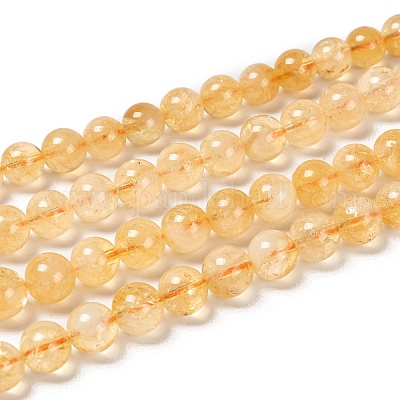
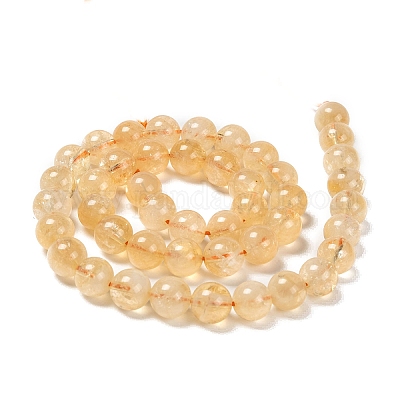
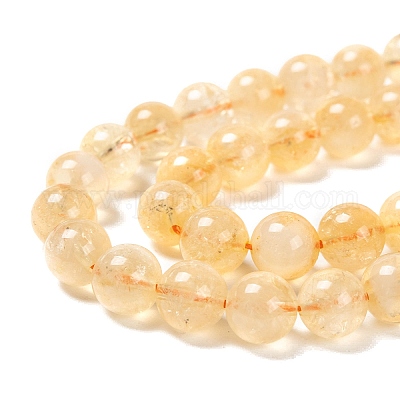
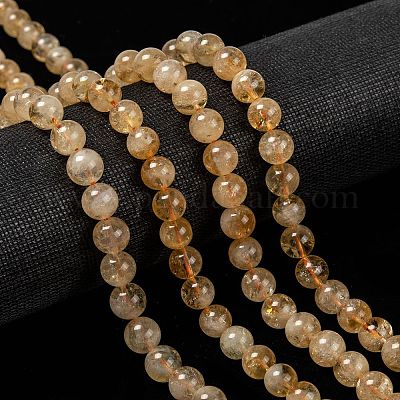
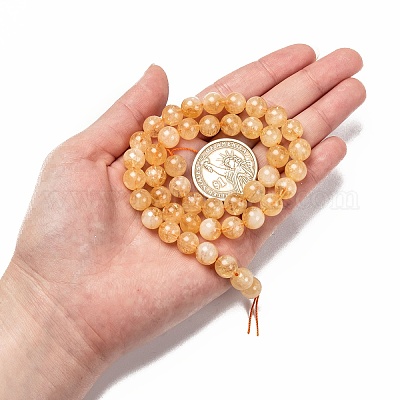
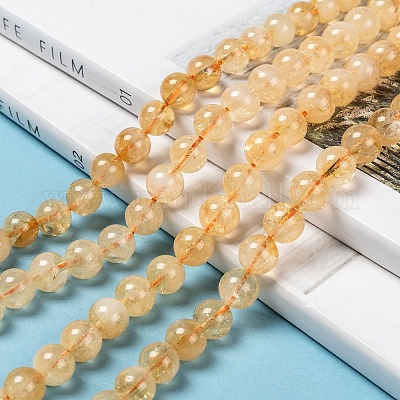
Natural Citrine Beads Strands, Round,
Size: about 8mm in diameter, hole: 1mm; about 49pcs/strand, 15.5 inch(39.5cm).
Spiritual Properties of Citrine: Citrine is often referred to as the "stone of abundance" as it is believed to attract wealth, success, and prosperity into one's life. It is said to enhance financial and material prosperity, promote generosity, and help manifest desires and goals. With its cleansing chakra energy, citrine can help release negative energy and promote overall well-being, supporting emotional healing and balance.
※ Please note that there is no specific scientific evidence to prove the therapeutic effects of stones, but gemstone therapy meditation may induce a placebo effect that helps you relax the mind.
Priced per 2 Strands
Please Note: Sizes, shapes and colors may vary slightly with natural materials and different batches of production.
What is Chakra?
In yoga, meditation and Ayurveda, there are 7 major powerful energy centers in human body called chakra (chakra means " wheel, circle " in Sanskrit). They begin at the base of your spine and end at your head.
Each chakra contains not only the nerve bundles and major organs, but also the presence of mental and emotional states. When the chakra is open and kept in proper alignment, you’ll feel your mind, organs, and intellect performing at their optimal level.
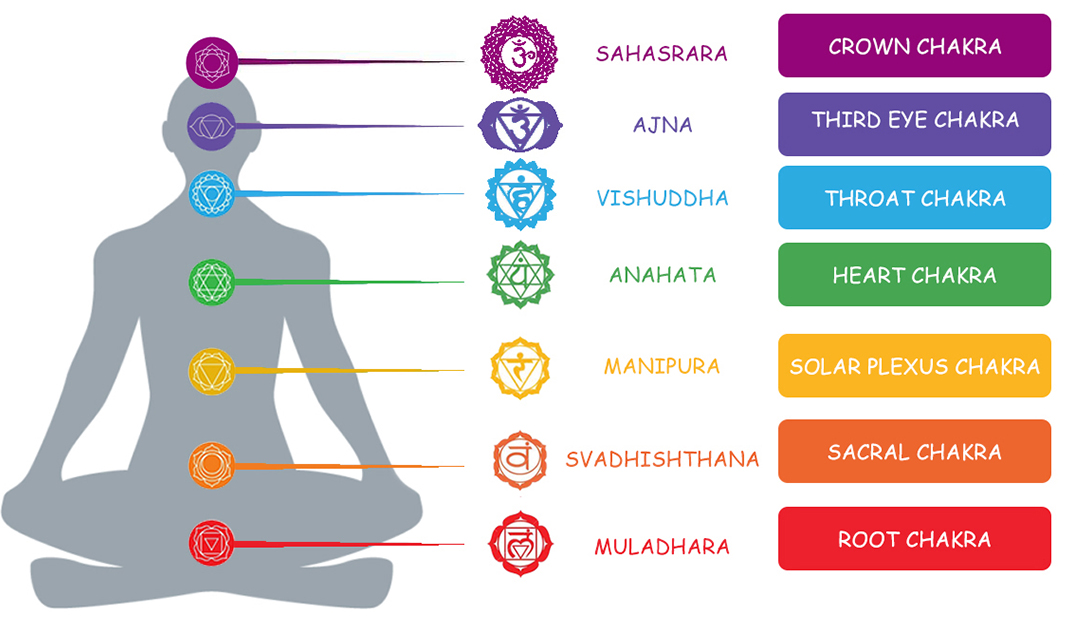
The Meanings of Chakra
| Image | Name | Color | Location | Seed Syllable | Meanings |
 |
Crown Chakra/ Sahasrara |
Violet/ white | Crown | Aum/Om | Sahasrara means " thousand " or " infinite " in Sanskrit and symbolizes your spiritual connection to yourself, others and the universe. It’s believed that the crown chakra has a great impact on brain functions such as memory, intelligence and concentration. |
 |
Third Eye Chakra/Ajna |
Indigo | Between eyebrows | Aum | Ajna means perception and is responsible for your intuition. This chakra will bring a deeper understanding of things or connections that are not easily sensed. |
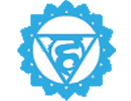 |
Throat Chakra/ Vishuddha |
Blue | Throat | Ham | Vishuddhi means "purest" and aims at expressing in an unrestricted and honest manner without reservation. This chakra is responsible for the ability to communicate verbally. |
 |
Heart Chakra/ Anahata |
Green | Heart | Yam | Anahata means " unhurt ". It’s associated with the ability of loving oneself and others, and to show compassion. |
 |
Solar Plexus Chakra/ Manipura |
Yellow | Navel | Ram | Manipura means " Jewel city ", a dazzlingly beautiful place. It’s associated with yellow, a color that shines like the sun and is full of power. This chakra will make you feel confident and motivated, and gain more control over your life. |
 |
Sacral Chakra/ Svadhisthana |
Orange | Below navel | Vam | Svadhisthana means " one’s own dwelling ". This chakra, the driving force for enjoying life, has to do with sexuality, creativity, emotions and the way we cultivate joy and overall enjoyment in our lives. |
 |
Root Chakra/ Muladhara |
Red | Base of spine | Lam | Muladhara means "root support". The root chakra is associated with stability and security. It will make us feel grounded and secure, and give us the motivation to live and achieve. |
Tips: There are also products with multi-chakra design being sold on our website.
Chakra Gemstone Beads
It’s believed that you can bring the energy of chakra colors into your life when you’re working with it.
You can make 7-Chakra orgone bracelets or necklaces with chakra gemstone beads of 7 colors and wear it on your body or keep it in your pocket, this will make you feel healed, relaxed and more focused, thus improving your working efficiency and life satisfaction.

Crown Chakra


Third Eye Chakra


Throat Chakra


Heart Chakra


Solar Plexus Chakra


Sacral Chakra


Root Chakra


Chakra Jewelry


DIY Chakra Jewelry


Other Chakra Healing Products


The Meaning of Gemstone
Gemstone (also called as gem, jewel, precious stone or semiprecious stone) is a general term for natural gemstones and manufactured stones.
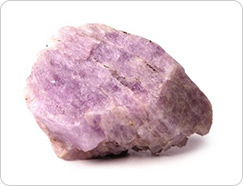
Natural Gemstones are minerals or organic matters that are produced from nature. They can be cut and polished for use as jewelry or other adornments. Most Gemstones are hard, durable and rare with great aesthetic value, including natural gemstones, natural jades and natural organic materials (such as pearl and amber).
Manufactured Stones are materials that are produced wholly or partly by hand for use as ornaments. Our manufactured stones include synthetic gemstones, assembled gemstones and imitation stones.
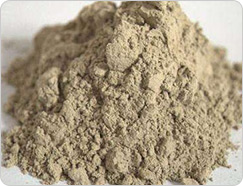
Synthetic Gemstones are man-made crystals, non-crystalline solid or aggregates, which may be with chemical, optical and physical characteristics of its natural mineral counterpart.
Assembled Gemstones are made of two or more pieces of materials by artificial splicing that give the impression of gems. The components may be natural or man-made materials.
Imitation Stones are gemstones or other materials used to imitate the look and color of a kind of stone, but possess neither their chemical nor physical characteristics.
-
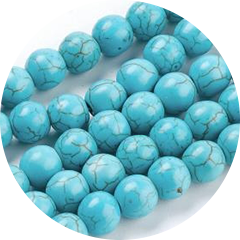 Synthetic
Turquoise Beads -
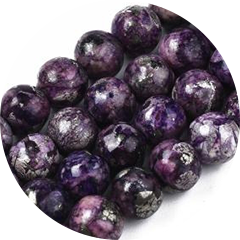 Assembled Synthetic
Charoite and Pyrite Beads -
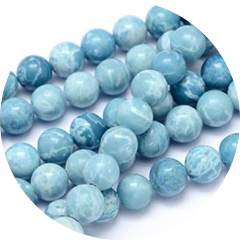 Imitation
Larimar Beads
Enhancement and Treatment
Except for cutting and polishing, gemstones are often treated to enhance the color, luster, clarity, optical characteristics, durability or usability of the stone. Color treatment of our gems is divided into Dyed, Dyed & Heated and Electroplated.
Dyed: Infiltrating color-causing substances (such as colored oils, dyes, etc.) into gemstone by chemical methods to improve or change the color of gemstones. Dyed Jade is commonly treated in this manner.
Dyed & Heated: To improve or change the color of gemstones by heating and dying process, such as most Red Agate, Black Agate and Red Tiger Eye are dyed and heat-treated.
Electroplated: The surface of gemstone is covered with a thin film by plating to change its color or luster, such as Electroplated Quartz Crystal, Electroplated Lava Rock.
Gemstone Nomenclature
Gemstone Names are divided into classic name and trade name.
The Classic Name of Gems is a mineralogical, petrological, material and traditional gemological name of gem varieties. Most gemstone names are based on the mineral, such as Garnet, Turquoise, Lapis lazuli, Malachites, etc.
The Trade Name of Gems is another name widely used and generally recognized in gemstone trade, for example Larimar is the trade name for a rare blue variety of silicate mineral pectolite.
Different Title Requirements of Gemstone Products
Five main criteria for gemstone product titles:
1.If it is a natural gemstone with natural color, its title must contain the word "Natural".
2.If it is a natural gemstone with treated color, its title must contain the word "Natural" and "Dyed" or "Dyed & Heated" or "Electroplated".
3.If it is a synthetic gemstone, its title must contain the word "Synthetic".
4.If it is a assembled gemstone, its title must contain the word "Assembled".
5.If it is a imitation gemstone, its title must contain the name of the original material and imitation stone.
Tips: if you want to purchase a natural gemstone with natural color, you can click attribute of“Natural” and “Undyed”.
Bead Size
Natural gemstones and semi-precious stones come from minerals. Due to their natural origin, the stones may have tiny flaws. Additionally, cutting or polishing can also cause each gemstone to vary slightly in size, especially when produced in different batches. But please note that the size variation for each bead is generally within 0.2mm to 0.75mm of the stated size, and the bead hole size can vary by up to 0.2mm. For example, for 8mm round beads, the size range on a strand may vary between 7.8mm and 8.75mm, with some beads measuring 8mm, 8.2mm, or even 8.5mm. In reality, a 0.5mm difference is hardly noticeable to the naked eye. Similarly, if the bead hole is described as 1mm, the actual size may range from 0.8mm to 1.2mm.
Beads Quantity on Each Strand
Because of the error range of bead size, the quantity may have some difference in the beads strands with same length, error range of 1~3 beads.
For Example: 3 strand of 15 inch 6mm Natural Yellow Jade beads , beads quantity is 59pcs, 60pcs, 61 pcs.
 59 pcs
 60 pcs
 61 pcs

As shown:
The bead size may vary in different
batches.The bead size may vary in different batches.
The bead size may vary in different
batches.The bead size may vary in different batches.
Customer Questions
 For natural color gemstones of the same grade, why some products our customers receive have a little difference in its color from the products picture?
 This difference in color is based on the atomic structure of the stone. Every gemstone has its own unique chemical and atomic structure, even the same named gemstone can occur in many different colors, especially in different lots.
For natural dyed gemstones, why some products our customers receive has a little difference in its color from the products picture?
Because these beads are made in small batches, the dyed color could be slightly different from one batch to another. And the main reason is that the density, color and texture characteristic of a natural stone will lead to different coloring effects, some are darker, some are lighter. But a big color difference is not allowed. We will try our best to supply gemstone products which are consistent with the pictures.
How to Care for and Clean Gemstone Beads
Avoid Chemicals: Keep beads away from strong acids, alkalis, and corrosive chemicals. Apply perfume or spray before wearing jewelry and allow it to dry completely.
Prevent Physical Damage: Avoid collisions or scratches by storing beads separately. Remove jewelry during physical activities or housework to prevent impact or pressure.
Avoid Extreme Temperatures: Store beads in a cool, shaded area to prevent UV damage or fading. Maintain an ideal environment with temperatures between 18–24°C and humidity levels of 40–60%.
Regular Inspection: Inspect stringing materials for wear, fading, or damage.
Clean Regularly: Clean your gemstone beads regularly to remove dirt and oils that can dull their appearance.
Gemstone beads require different cleaning methods based on their hardness. The following are recommended cleaning methods for gemstone beads with a hardness of 4 or higher on the Mohs scale.
Mild Cleaning Solution: Mix a few drops of a gentle soap (such as gemstone cleaner) with warm water. Soak the beads for 10–15 minutes.
Soft Brush Cleaning: Use a soft-bristled brush, like a clean toothbrush, to gently scrub the beads. Avoid using too much force to prevent surface scratches.
Rinse and Dry: Rinse thoroughly under running water to remove any soap residue. Dry the beads with a clean, soft towel.
Tips: For gemstone beads with a Mohs hardness of less than 4, such as Selenite, Rhodochrosite, Lepidolite, Amber, Chrysocolla, Shungite, Magnesite, Angelite, and dyed gemstones, it is recommended to wipe them with a clean, soft cloth. Do not use soapy water.





 iOS APP
 Google Play
